Smith College Professor Guides Students in Addressing Climate Reality Through Fiction
News of Note
Allegra Hyde uses her expertise to help students write about the environment in unexpected ways

Several of the zines created during Allegra Hyde’s Writing Climate Fiction class. Photo by Jessica Scranton
Published January 23, 2026
Allegra Hyde was young when she first realized that although she was most likely too nervous to chain herself to a tree, she did want to find a way to save them.
“I’ve always been someone who cared about environmental activism,” says Hyde, an author and assistant professor of English language and literature at Smith College. “It’s not that I haven’t participated in protests, but I just felt like as someone who also loved to write fiction, that really intentionally bringing environmental ideas and messaging into my stories and novels is a small way I can contribute to a larger cultural conversation.”
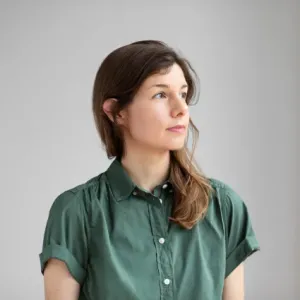
In Hyde’s new class, Writing Climate Fiction, Smithies are using their writing skills to make their own contributions.
Offered last semester and described as a course that “teaches students how to use fiction as a tool for engaging with the realities of climate change,” Writing Climate Fiction sounds straightforward enough, but with the support of a curricular enhancement grant from the Center for the Environment, Ecological Design & Sustainability (CEEDS), Hyde was able to develop it into a more multidimensional experience. For example, she arranged a trip to MacLeish Field Station where students began the semester reading and analyzing examples of climate fiction (or “cli-fi”) and writing pieces inspired by the nature around them. She also hosted several guest lectures from contemporary cli-fi authors who discussed how they engage with a subject as complex and—frankly, depressing—as climate change.
For Hyde and her students, that meant taking different—and sometimes unexpected—approaches to storytelling.
“[Climate change] is something so vast, complicated, and political, at times,” Hyde says. “For me as an author, I use a lot of humor to balance out the grimmer realities of our world, and working with students, it was definitely a tool we utilized. We also experimented with stepping out of human frameworks and writing from an animal’s perspective, as well as with using a utopian lens to try problem solving on the page rather than just imagining worst-case scenarios. It’s all about figuring out how to distill environmental concepts that can, for most people, be intimidating, overwhelming, or boring, but that are so important to make part of our everyday conversations.”
“I just felt, as someone who also loved to write fiction, that really intentionally bringing environmental ideas and messaging into my stories and novels is a small way I can contribute to a larger cultural conversation.”
One part of the course Hyde particularly enjoyed was giving students the chance to blend STEM and the humanities in their creative work, especially those who may have only had experience in one field or the other.
“I love that this is the sort of class that allows students to try different things they might not even realize they like,” she says. “I had a number of STEM students for whom this was their first creative writing class and they, I think, had perhaps been intimidated by other humanities classes because they’re out of their comfort zone, but this provided a way for them to bridge the gap a bit. There were also students who were maybe majoring in English and had to grapple with how to synthesize heavy-duty science into something that’s accessible to a wide readership. It was really neat to work with everyone’s expertise and have lots of different skills, abilities, and bodies of knowledge in the room together.”
At the conclusion of the semester, Hyde and her students collaborated with the librarians at the Hillyer Art Library to adapt the students’ stories into zines. Students were inspired by everything from The Last of Us and Greek mythology to animals and fungi they observed during their time at MacLeish.
“It wasn’t easy,” Hyde says of creating the zines. “It was a learning experience for everyone, but it was really exciting to write together, to be in community. I think it’s that same energy that feels most important to the environmental movement as well.”