How a Smith College Student Became a Leading Voice Against Book Bans
News of Note
Julia Garnett ’28 channels her love of books through her free-speech activism

As. part of her free-speech activism, Julia Garnett '28 has hosted free speech open mic events.
Published January 21, 2026
Smith College student Julia Garnett ’28 likes to strike up conversations with Uber drivers and people in airports.
“I always find people who want to talk”—even about controversial subjects, she says.
Garnett, a government major, doesn’t shy away from difficult conversations. In high school, she successfully took on the school board in her hometown of Hendersonville, Tennessee, to prevent the banning of A Place Inside of Me, a narrative poem by a young Black boy, reflecting on his emotions after a police shooting in his community.
Since then, Garnett has worked with groups including the National Coalition Against Censorship, the South Carolina-based Diversity Awareness Youth Literacy Organization, and the Massachusetts Center for the Book to promote free speech and literacy.
At Smith, she helped organize a campus event for Banned Books Week in October, and is one of two student members of the Committee on the Library, serving as a liaison between students and the college libraries.
Hannah Gates, community engagement organizer for Smith’s Jandon Center for Community Engagement, where Garnett was a fellow last fall, says Garnett was “an incredible asset” to student-led work with area nonprofits.
From raising money for local literacy groups to organizing intergenerational storytelling sessions, “Julia always approached her work with a sense of humor and cheer,” Gates says. “I admire her commitment to empathetic perspective-taking, and her constant desire to learn from every experience and community member.”
This semester, Garnett will be a member of Smith’s LEAD Corps campus leadership development program. She also plans to stay engaged with local and statewide anti-book-banning groups.
Here, Garnett shares some thoughts about why she is drawn to free-speech issues, and what she has learned from her activism.
How did you first become involved in anti-book-banning efforts?
“My mom is an elementary school special-ed teacher and I grew up with books everywhere. I’ve always loved to read. In my hometown in Tennessee, the school board was talking about removing a book [A Place Inside Me] from the school library. I wrote a speech and I went to the school board meeting. I had no idea what I was walking into. The room was packed and felt very divided. It was palpable in the air. I went up and spoke about how this [ban] would impact students—I was one of the only students there. The board didn’t want to make a decision there in that room. They had to come back, and in the end, they did vote to keep the book.”
Why do you care so much about books and literacy?
“Books are a window into different experiences. Growing up as a queer person, I didn’t have a lot of information that would have helped me come out. The message sent to young queer people—or young people in general—when their stories are removed from libraries just feels wrong. Luckily, I had great librarians who helped me, even though they didn’t feel they could really talk about books or book bans. Librarians are under pressure to self-censor. But our country was founded on freedom. It makes me angry when I can’t access information.”
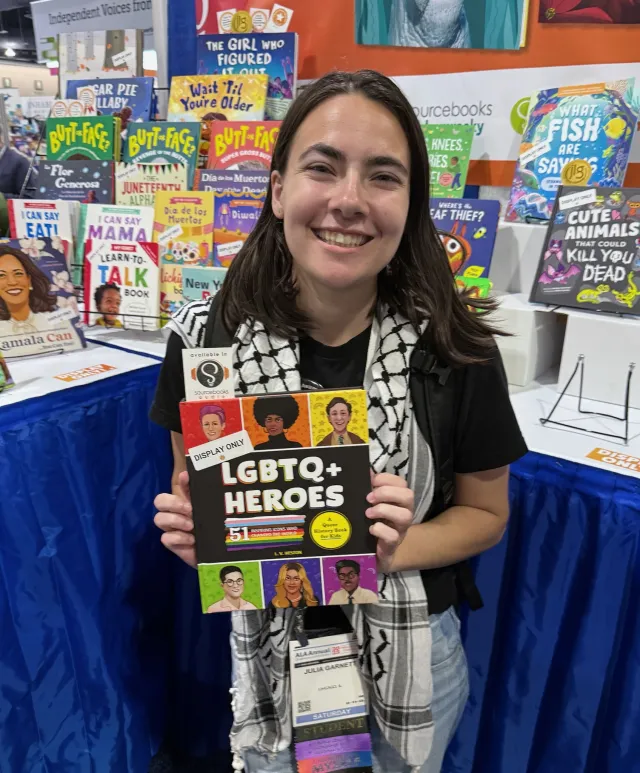
In 2024, you served as co-chair of National Banned Books Week with film director Ava DuVernay. What was that like?
“That was amazing. I got to interview her on Zoom, and afterwards she said, ‘I’m so proud of you’ and then she followed me on Instagram!”
What’s new on the book-banning front?
“A lot of the issues I’ve been fighting since high school are getting worse. Right now, public libraries in Tennessee are reviewing books for LGBTQ+ content. The library board in my hometown has just added [book ban supporter] Riley Gaines as a board member. But there’s also a wave of people getting involved. In Massachusetts, we now have a proposed new bill [An Act Regarding Free Expression, which prohibits politically biased book challenges] that gives me a lot of hope. There are public libraries that are giving free e-library cards to people so they can read banned books. I hate that we have to fight book bans, but the attention is also getting people reading again.”
How does your activism fit into your studies at Smith?
“Coming into Smith, I had a lot of passion, but not enough actual information behind all of it. My professors have been so incredible—they send me book recommendations. I’ve also really liked talking to students from other countries about how they see censorship and how they’ve responded in places where governments are more controlling.”
What have you learned from being involved in free-speech organizing?
“I’ve gained so much confidence. It’s important to accept people for who they are, but also to be unapologetic about who I am. To be able to have conversations with a wide variety of people—a lot of it is about finding their humanity. There’s so much that really should not be political. I am learning how to be myself in every space.”